
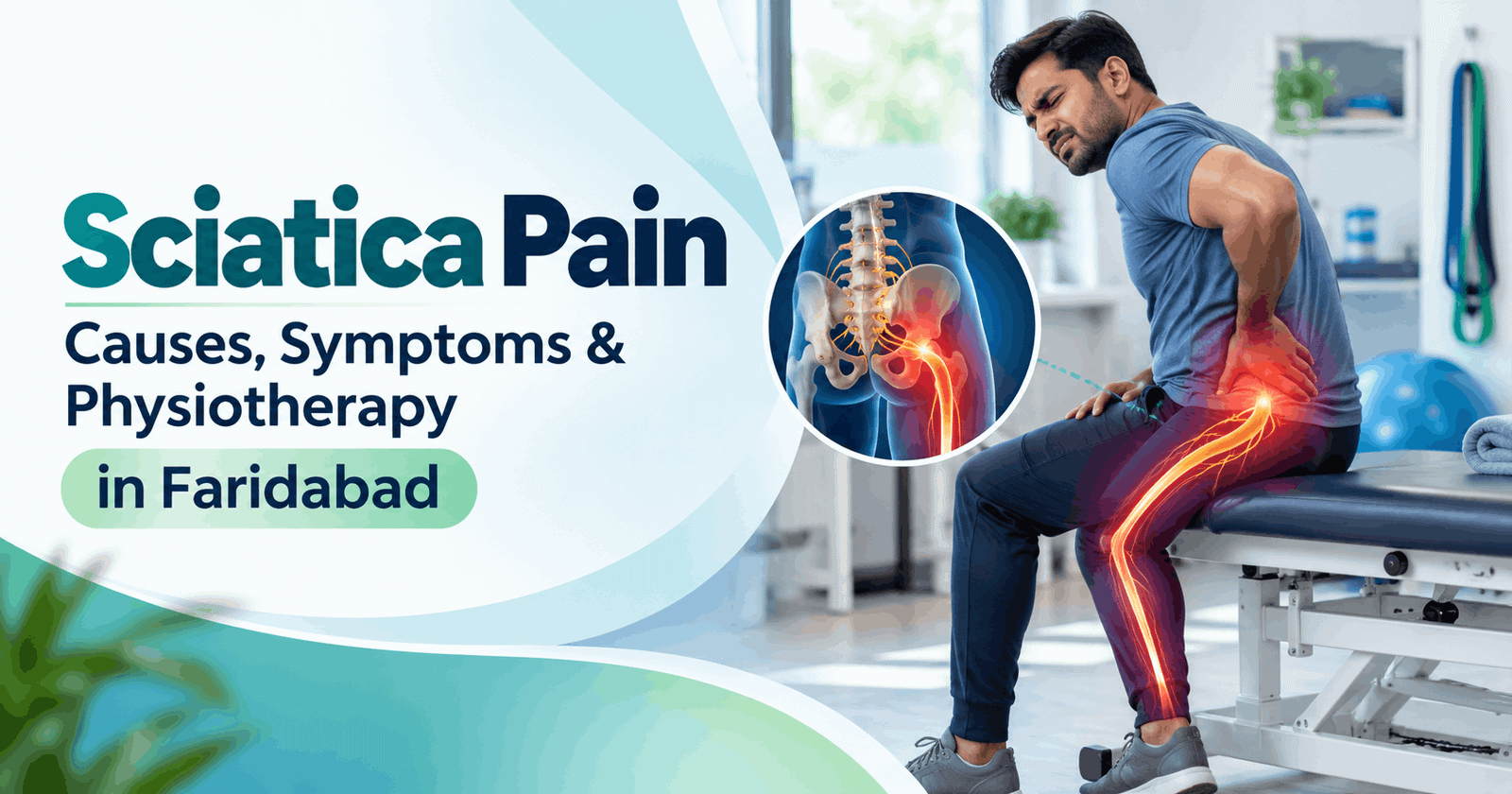
Sciatica pain can make something as simple as sitting, walking, bending or getting out of bed uncomfortable. For some people, the pain begins in the lower back and travels through the buttock into the leg. Others experience burning, tingling, numbness or weakness.
Sciatica generally develops when a nerve root contributing to the sciatic nerve becomes irritated or compressed. Common causes include a herniated disc, spinal stenosis and other changes affecting the lower spine.
The good news is that many cases can improve without surgery. Appropriate activity, physiotherapy, education and a personalised rehabilitation programme may help restore movement and function.
At PhysioMotion Physiotherapy & Rehabilitation Clinic in Faridabad, assessment focuses on understanding why your symptoms are occurring rather than treating every patient with the same programme.
Table of Contents
- What is sciatica pain?
- What causes sciatica?
- Common symptoms of sciatica
- Why does sitting increase sciatica pain?
- 7 ways physiotherapy may help
- Exercises and movement
- When sciatica requires urgent medical attention
- How long does recovery take?
- Sciatica physiotherapy in Faridabad
- Frequently asked questions
What Is Sciatica Pain?
Sciatica pain describes pain associated with irritation or compression of nerve roots that contribute to the sciatic nerve.
The sciatic nerve pathway extends from the lower back through the buttock and down the leg. Because of this, symptoms are not always limited to the back.
The NHS describes common symptoms as sharp or burning leg pain, tingling, numbness and weakness, usually affecting the buttock and the back of one leg.
That is why someone with sciatica may experience relatively mild back discomfort but significant pain further down the leg.
Sciatica also differs from ordinary lower-back pain. Pain limited only to the back without radiating neurological symptoms may have another cause and requires proper assessment.
What Causes Sciatica Pain?
There is no single cause of sciatica pain.
A physiotherapist therefore needs to assess symptoms, movement, strength, neurological signs, posture and functional limitations before creating an appropriate rehabilitation programme.
1. Herniated or Slipped Disc
A spinal disc contains a softer centre surrounded by a tougher outer layer.
When part of the disc protrudes and irritates or compresses a nearby nerve root, pain may travel down the leg.
Disc herniation is one of the most recognised causes of sciatica.
2. Spinal Stenosis
Spinal stenosis involves narrowing of spaces within the spine.
This narrowing can place pressure on nerve structures and may contribute to leg pain, tingling, numbness or weakness.
3. Spondylolisthesis
Spondylolisthesis occurs when one vertebra moves relative to another.
In some cases, this can reduce space around a nerve root and contribute to symptoms.
4. Age Related Spinal Changes
Changes involving discs, joints or bone may alter the space available for spinal nerves.
These changes do not automatically mean someone will develop symptoms, which is another reason imaging findings should be interpreted together with a clinical assessment.
5. Back Injury
Trauma or injury affecting structures around the lumbar spine can also irritate nerve tissue.
The NHS lists slipped discs, spinal stenosis, spondylolisthesis and back injuries among recognised causes of sciatica.
If your symptoms are related to the lower back or spine, you can also read about PhysioMotion’s spinal rehabilitation in Faridabad programme.
Common Symptoms of Sciatica Pain
Sciatica pain can feel different from one person to another.
Common symptoms include:
- Pain travelling from the lower back or buttock into the leg
- Burning or shooting leg pain
- Electric shock like sensations
- Tingling or pins and needles
- Numbness
- Leg or foot weakness
- Pain aggravated by prolonged sitting
- Symptoms aggravated by coughing or sneezing
- Difficulty bending, walking or changing position
Mayo Clinic notes that symptoms commonly affect one side of the body and may extend through the buttock, thigh and calf.
Some people experience pain while another part of the leg feels numb.
That combination is another reason persistent radiating pain should be properly assessed rather than automatically treated as ordinary muscle pain.
Why Does Sitting Increase Sciatica Pain?
Many patients report that their sciatica pain becomes worse after prolonged sitting.
Sitting changes the position of the hips, pelvis and lumbar spine. Depending on the underlying cause and the individual’s symptom pattern, remaining in one position for long periods can aggravate irritated nerve structures.
Mayo Clinic specifically notes that sciatica symptoms may become worse after sitting for a long time.
That does not mean sitting itself is always harmful.
The important factor is usually how symptoms respond to particular positions, movement and duration.
Frequent changes in position and appropriate movement may be more useful than trying to maintain one supposedly “perfect” posture throughout the day.
PhysioMotion’s postural assessment and rehabilitation services can help identify movement and postural factors that may be relevant to an individual’s symptoms.
7 Proven Approaches That May Help Sciatica Pain
Treatment should depend on the cause, severity and behaviour of your symptoms.
A physiotherapy programme should therefore be personalised rather than copied from a generic exercise video.
1. Stay Appropriately Active
Complete bed rest is generally not recommended for uncomplicated sciatica pain.
The NHS advises people with sciatica to continue normal activities as much as possible and begin gentle movement when appropriate.
Movement may initially need to be modified according to symptoms.
The goal is usually to remain active without repeatedly provoking significant symptoms.
2. Use Individualised Therapeutic Exercise
Exercise selection depends on your clinical presentation.
A physiotherapist may prescribe movements aimed at improving:
- Lumbar mobility
- Hip mobility
- Core control
- Lower limb strength
- Movement tolerance
- Balance
- Functional capacity
The American Physical Therapy Association’s ChoosePT guidance explains that physiotherapy programmes for lumbar radiculopathy can include personalised exercises aimed at improving movement and helping patients return to everyday activities.
At PhysioMotion, therapeutic exercise is also incorporated into its orthopedic rehabilitation programme.
3. Improve Core and Spinal Strength
Core training is not simply about doing abdominal exercises.
The objective is to improve the ability of muscles around the trunk, hips and spine to support controlled movement.
Mayo Clinic notes that physical therapy for sciatica may include exercises intended to strengthen the core, improve posture and improve range of motion.
The appropriate level should be determined according to symptoms and physical capacity.
4. Gradually Restore Mobility
Some people with sciatica pain become increasingly stiff because they avoid movements that they expect to hurt.
Appropriate mobility exercises can gradually restore confidence and movement.
Depending on the person, rehabilitation may address the lower back, hips, hamstrings and other areas influencing functional movement.
Aggressive stretching is not automatically better.
Certain movements may aggravate symptoms in some individuals, which is why treatment should be based on assessment.
5. Consider Nerve Mobility Exercises When Appropriate
Nerve mobility exercises are sometimes used during spinal rehabilitation when symptoms are associated with nerve irritation.
These movements are different from simply stretching a muscle.
They are intended to encourage controlled movement of neural structures relative to surrounding tissues.
PhysioMotion’s current spinal rehabilitation service includes nerve mobility exercises when clinically appropriate.
They should not be performed aggressively or assumed to be appropriate for every case.
6. Improve Daily Movement and Ergonomics
Treatment should extend beyond the physiotherapy clinic.
The way you sit, work, bend, lift, exercise and change positions throughout the day can affect symptom behaviour.
Rehabilitation may therefore include:
- Sitting modifications
- Workstation guidance
- Safe lifting techniques
- Movement retraining
- Position changes
- Gradual return to activity
This is particularly relevant for people in Faridabad and Delhi NCR who spend long working hours at computers, driving or commuting.
The aim is not to create fear around posture.
It is to help your body tolerate everyday activities more comfortably.
7. Follow a Progressive Rehabilitation Programme
Reducing pain is only one part of recovery.
Once acute symptoms settle, rehabilitation should progressively rebuild the strength, mobility, endurance and confidence required for normal activities.
This may include returning to:
- Walking
- Work
- Gym training
- Household activities
- Running
- Sports
- Prolonged sitting or travelling
For persistent symptoms, PhysioMotion also provides chronic pain management in Faridabad alongside spinal and orthopedic rehabilitation.
Should You Exercise With Sciatica Pain?
In many uncomplicated cases, gentle and appropriately selected activity can be useful.
However, there is no universal exercise routine for sciatica pain.
One person may feel better with a particular spinal movement while another person’s symptoms may worsen with the same exercise.
Exercise selection should consider:
- What movements aggravate symptoms
- What movements reduce symptoms
- Muscle strength
- Neurological findings
- Mobility
- Medical history
- Daily activities
- Diagnosis
- Functional goals
This is why random online exercises should not replace individual assessment when symptoms are severe, persistent or associated with neurological changes.
You can read more about the clinic’s overall approach on the PhysioMotion physiotherapy services page.
When Is Sciatica Pain an Emergency?
Most cases are not emergencies.
However, certain symptoms require urgent medical evaluation.
Seek urgent medical care if sciatica pain occurs with:
- New difficulty controlling your bladder
- Loss of bowel control
- Numbness around the genitals, groin or saddle region
- Severe or rapidly worsening weakness
- Severe symptoms affecting both legs
- Major trauma
These symptoms can indicate serious neurological compression.
The NHS specifically advises emergency assessment for symptoms including severe or worsening weakness in both legs, numbness around the genitals or anus, and new bladder or bowel dysfunction.
Do not wait for a routine physiotherapy appointment when these warning signs are present.
How Long Does Sciatica Pain Take to Improve?
Recovery time varies.
The NHS states that sciatica often improves within several weeks to a few months, although symptoms can sometimes persist longer or return later.
Recovery may be influenced by:
- Cause of nerve irritation
- Severity of symptoms
- Neurological involvement
- Overall health
- Physical activity
- Strength and mobility
- Duration of symptoms
- Adherence to rehabilitation
- Work and lifestyle demands
A fixed promise such as “sciatica will disappear in seven days” is therefore not medically realistic.
Progress should instead be measured through changes in pain, leg symptoms, mobility, strength and ability to perform normal activities.
Sciatica Pain Physiotherapy in Faridabad
If sciatica pain is affecting your walking, sitting, work, sleep or daily activities, a detailed physiotherapy assessment can help determine what may be contributing to the problem.
PhysioMotion Physiotherapy & Rehabilitation Clinic provides assessment led physiotherapy for people with spinal, musculoskeletal and movement related conditions in Faridabad. The clinic’s existing spinal rehabilitation programme specifically includes sciatica among the conditions it manages.
Treatment may include clinically appropriate combinations of:
- Movement assessment
- Strength testing
- Neurological assessment
- Therapeutic exercises
- Core strengthening
- Mobility training
- Nerve mobility exercises
- Manual therapy
- Ergonomic guidance
- Functional rehabilitation
- Home exercise planning
You can learn more about PhysioMotion and its physiotherapy approach or explore the clinic’s complete rehabilitation services.
Frequently Asked Questions About Sciatica Pain
Can physiotherapy help sciatica pain?
Physiotherapy may help suitable patients improve mobility, strength, movement tolerance and functional ability. Treatment should be based on the underlying cause and individual presentation rather than using the same exercises for everyone.
Is walking good for sciatica?
Gentle walking can be appropriate for many people if it does not significantly aggravate symptoms. Activity should be adjusted according to symptom response.
Does sciatica always require surgery?
No. Many cases improve without surgery. Surgery is generally considered in specific situations, including serious neurological problems or persistent symptoms that have not responded appropriately to conservative management.
Can prolonged sitting worsen sciatica?
Yes, prolonged sitting can aggravate symptoms in some people. Changing position regularly and gradually improving tolerance may help.
Can sciatica come back?
Yes. Sciatica can recur. Maintaining physical activity, strength, safe movement habits and appropriate management of contributing factors may help reduce recurrence risk.
Where can I get sciatica physiotherapy in Faridabad?
PhysioMotion Physiotherapy & Rehabilitation Clinic provides spinal rehabilitation and physiotherapy in Faridabad for people experiencing sciatica, lower back pain and other movement related conditions.
Get Your Sciatica Pain Assessed at PhysioMotion
Persistent sciatica pain should not automatically be treated as ordinary back pain.
Understanding where the symptoms originate, what movements aggravate them and whether strength or neurological changes are present can help guide an appropriate rehabilitation programme.
PhysioMotion Physiotherapy & Rehabilitation Clinic is located in Sector 89, Faridabad, and provides personalised physiotherapy and rehabilitation led by clinical assessment. The clinic lists spinal rehabilitation, orthopedic rehabilitation and chronic pain management among its services.
Book your physiotherapy assessment at PhysioMotion
Call: +91 98124 60558
PhysioMotion Physiotherapy & Rehabilitation Clinic
Shop No. 6, Adore Samriddhi, Piyush Heights, Sector 89, Faridabad, Haryana.
This article is for educational purposes and does not replace an individual medical or physiotherapy assessment.