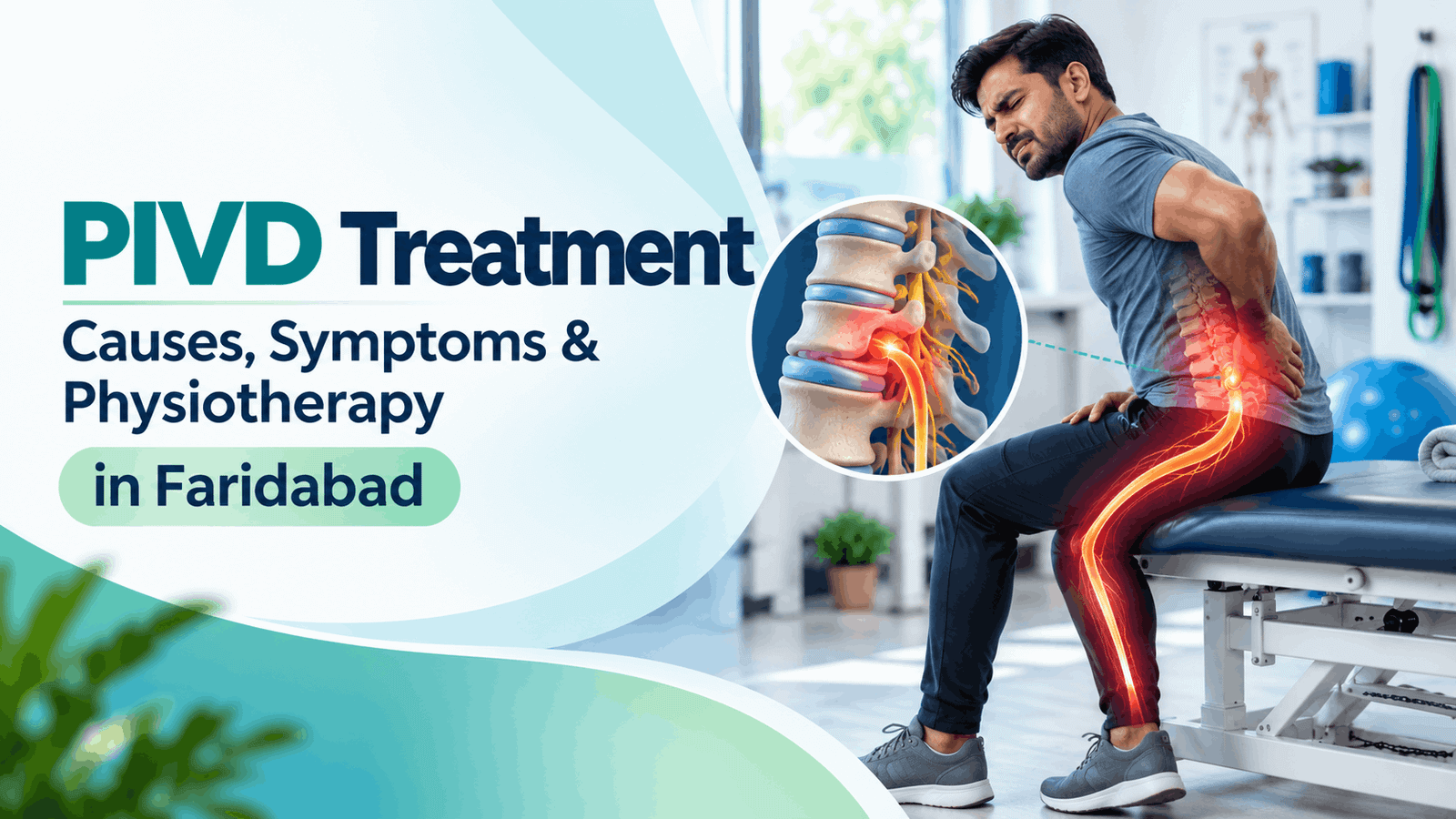
PIVD treatment is designed to reduce pain, manage nerve-related symptoms, restore comfortable movement and help patients gradually return to normal daily activities. PIVD, or Prolapsed Intervertebral Disc, is commonly referred to as a slipped disc or herniated disc.
For many people, a disc prolapse does not automatically mean surgery. Conservative management, including appropriate activity modification and physiotherapy, is commonly used first when there are no urgent neurological warning signs. The NHS notes that slipped-disc symptoms often improve gradually with appropriate activity, exercise and medical management.
At PhysioMotion Physiotherapy & Rehabilitation Clinic, we provide assessment-led PIVD treatment in Faridabad with rehabilitation planned around the patient’s symptoms, neurological findings, mobility, strength and functional requirements.
If disc-related symptoms are interfering with sitting, walking, working, sleeping or exercising, understanding the condition is the first step towards an appropriate recovery plan.
What Is PIVD?
PIVD stands for Prolapsed Intervertebral Disc.
Your spine contains vertebrae separated by intervertebral discs. These discs help distribute forces through the spine and allow movement between the vertebrae.
A disc contains a softer central portion surrounded by a stronger outer layer. When disc material protrudes or herniates beyond its normal position, it may irritate or compress a nearby spinal nerve.
This is commonly described using terms such as:
- Prolapsed disc
- Herniated disc
- Slipped disc
- Bulging disc
- Disc prolapse
- Disc herniation
A disc does not literally “slip” out of place. The term usually describes disc tissue bulging or protruding beyond its normal boundary.
PIVD most commonly affects the lower back, although disc problems can also occur in the cervical spine.
Patients experiencing disc-related spinal problems may also benefit from PhysioMotion’s Spinal Rehabilitation in Faridabad program.
Common Symptoms of PIVD
Symptoms depend on the location of the affected disc and whether nearby nerves are irritated.
Some people have disc changes without experiencing significant symptoms, while others can develop considerable pain or neurological symptoms.
Common symptoms may include lower-back pain, stiffness, difficulty bending, pain extending into the buttock or leg, tingling, numbness or muscle weakness.
When a lumbar disc irritates the sciatic nerve roots, pain can travel from the lower back or buttock into the leg. This is commonly called sciatica.
If leg pain is one of your main symptoms, read our detailed guide to Sciatica Pain: Causes, Symptoms & Physiotherapy in Faridabad.
What Causes a Prolapsed Intervertebral Disc?
PIVD does not always develop because of one specific event.
Changes in the disc can occur gradually, and symptoms may sometimes become noticeable after bending, lifting or another activity.
Factors associated with disc problems can include age-related disc changes, repetitive loading, improper lifting techniques, prolonged sitting, physical inactivity, smoking and excess body weight.
However, identifying a disc abnormality on an MRI does not by itself determine how much pain a person will experience.
This is why PIVD treatment should be based on the patient’s symptoms, clinical examination, neurological findings and functional limitations rather than imaging alone.
How Is PIVD Diagnosed?
Assessment usually begins with a detailed medical and physical evaluation.
A physiotherapist may assess your pain pattern, spinal movement, muscle strength, sensation, reflexes, functional movements and signs suggesting nerve involvement.
Depending on the presentation, additional medical assessment or imaging such as MRI may be required.
The goal is not simply to identify a disc abnormality. It is also important to understand how the condition is affecting movement and everyday function.
At PhysioMotion, spinal rehabilitation begins with assessment of pain, mobility, posture, muscle strength, flexibility, neurological symptoms and functional limitations.
Learn more about our approach to physiotherapy and rehabilitation in Faridabad.
PIVD Treatment: Can It Be Managed Without Surgery?
In many cases, yes.
Most people with a herniated disc do not require surgery. Conservative management can include remaining appropriately active, medication when medically recommended, physiotherapy, activity modification and gradual exercise progression.
The American Physical Therapy Association’s ChoosePT guide also notes that many people with a herniated disc respond well to physical therapy and can return progressively to normal activity.
However, the correct treatment depends on factors such as symptom severity, neurological involvement, duration of symptoms and response to conservative treatment.
7 Powerful Steps Used in PIVD Treatment and Rehabilitation
1. Detailed Physiotherapy Assessment
Effective PIVD treatment begins with understanding the patient’s individual presentation.
Two people with similar MRI findings may experience very different symptoms and physical limitations.
Assessment may include spinal mobility, leg symptoms, muscle strength, neurological signs, movement tolerance, sitting tolerance, walking ability and functional activities.
This information helps determine an appropriate rehabilitation plan.
2. Pain and Symptom Management
During an irritated or painful phase, treatment focuses on making movement more manageable without unnecessarily aggravating symptoms.
Patients may be advised to temporarily modify activities that repeatedly increase symptoms.
Long periods of complete bed rest are generally discouraged. Both NHS and Mayo Clinic guidance encourage gradual activity rather than prolonged inactivity when medically appropriate.
For people with persistent symptoms, our Chronic Pain Management in Faridabad service focuses on movement, strength and long-term functional recovery.
3. Mobility Exercises
Movement may become restricted because of pain, muscle guarding or fear of aggravating symptoms.
Appropriate mobility exercises may be used to gradually restore comfortable spinal and hip movement.
There is no single exercise that is appropriate for every person with PIVD.
Exercise selection should depend on how symptoms respond to different movements and positions.
4. Core and Spinal Strengthening
Progressive strengthening can improve the physical capacity of muscles supporting the spine, hips, pelvis and abdomen.
The goal is not simply to strengthen one isolated muscle.
Rehabilitation should prepare the body for functional movements such as sitting, standing, walking, bending, lifting and returning to exercise.
ChoosePT describes strengthening, flexibility, posture, endurance and movement retraining as components that may be used during rehabilitation for a herniated disc.
You can learn more about broader physical rehabilitation through our Musculoskeletal Rehabilitation in Faridabad service.
5. Posture and Ergonomic Training
People with PIVD frequently ask whether poor posture caused their disc problem.
Posture is only one factor and should not be treated as the sole cause of spinal pain.
However, prolonged sitting or repeatedly remaining in uncomfortable positions may aggravate symptoms in some patients.
A physiotherapist may therefore assess sitting positions, workstation setup, movement breaks and daily movement habits.
PhysioMotion also provides dedicated Postural Assessment and Training in Faridabad.
6. Functional Movement Retraining
As symptoms improve, PIVD treatment should progress beyond basic exercises.
Patients need to regain confidence performing movements relevant to everyday life.
These may include walking, bending, lifting, climbing stairs, getting in and out of a chair, working at a desk, household activities and returning to the gym or sport.
Progression should be gradual and based on symptoms, strength and functional ability.
Patients requiring wider joint, muscle and movement rehabilitation can also explore our Orthopedic Rehabilitation in Faridabad program.
7. Home Exercise and Long-Term Prevention Strategy
Recovery should not depend entirely on treatment sessions.
A personalised home program may include mobility work, strengthening, walking or activity progression and strategies for managing recurring symptoms.
Patients may also receive education regarding lifting technique, activity progression and maintaining regular physical activity.
This helps support long-term spinal health and reduces unnecessary fear around movement.
PIVD Treatment in Faridabad at PhysioMotion
At PhysioMotion Physiotherapy & Rehabilitation Clinic, PIVD treatment in Faridabad is based on assessment rather than using the same treatment protocol for every patient.
Our approach can include symptom management, appropriate manual therapy, mobility exercises, progressive strengthening, core and trunk training, posture and ergonomic guidance, nerve mobility exercises when appropriate, functional movement training and a personalised home exercise program.
PhysioMotion is led by Dr. Deeksha Choudhary, BPT, MPT (Orthopaedics) and provides physiotherapy for musculoskeletal conditions, spinal problems, pain management and post-operative rehabilitation.
Explore all our physiotherapy services in Faridabad.
You can also learn more about PhysioMotion Physiotherapy & Rehabilitation Clinic.
PIVD Treatment for Sciatica
PIVD and sciatica are related but they are not identical conditions.
PIVD refers to a problem involving an intervertebral disc.
Sciatica describes symptoms caused by irritation or compression involving the sciatic nerve roots, typically producing pain that travels into the buttock or leg.
A lumbar disc herniation is one possible cause of sciatica.
Treatment therefore needs to address the complete clinical presentation rather than simply treating the MRI report.
Read our complete guide to sciatica pain and physiotherapy.
How Long Does PIVD Recovery Take?
There is no universal recovery timeline.
Recovery depends on the size and location of the disc problem, severity of nerve irritation, duration of symptoms, muscle weakness, general health, physical demands and response to treatment.
Some patients improve over several weeks with conservative management. ChoosePT notes that improvement can occur within weeks when an appropriate programme involving posture, symptom management, flexibility and strengthening is followed, although individual recovery times vary.
Therefore, PIVD treatment should focus on measurable functional progress rather than promising recovery within a fixed number of days.
When Is Surgery Considered for PIVD?
Surgery is not routinely required for every herniated disc.
A medical or surgical opinion may be considered when significant symptoms continue despite appropriate conservative management or when neurological problems are worsening.
Mayo Clinic notes that surgery may be considered when symptoms fail to improve with conservative treatment or when there is significant weakness, difficulty walking or standing, or loss of bladder or bowel control.
Patients recovering after spinal surgery may require structured rehabilitation based on their surgeon’s instructions and stage of healing.
Learn more about Pre and Post-Surgery Rehabilitation in Faridabad.
When Should PIVD Symptoms Be Treated as an Emergency?
Seek urgent medical assessment if back or leg symptoms are accompanied by:
- Loss of bladder or bowel control
- Difficulty passing urine
- Numbness around the groin, genitals or saddle region
- Rapidly increasing leg weakness
- Loss of feeling in one or both legs
- Severe symptoms after significant trauma
These symptoms can indicate serious neurological compression and should not be managed through routine physiotherapy alone.
PIVD Treatment Near Faridabad and Delhi
If you are searching for PIVD treatment near you in Faridabad, PhysioMotion provides assessment-led physiotherapy for slipped disc symptoms, disc-related lower-back pain, sciatica and associated movement limitations.
Our clinic serves patients from Faridabad and surrounding NCR areas seeking personalised spinal physiotherapy and rehabilitation.
PhysioMotion Physiotherapy & Rehabilitation Clinic is located in Sector 89, Faridabad.
View experiences shared by patients on our PhysioMotion Reviews page.
For appointments or clinic information, visit our Contact PhysioMotion page.
Frequently Asked Questions About PIVD Treatment
Can physiotherapy help with PIVD?
Physiotherapy can form an important part of conservative PIVD treatment. Depending on the patient’s condition, rehabilitation may include education, symptom management, mobility work, progressive strengthening and functional movement training.
Is PIVD the same as a slipped disc?
PIVD stands for Prolapsed Intervertebral Disc. The terms slipped disc, prolapsed disc and herniated disc are commonly used to describe related disc conditions.
Can PIVD be treated without surgery?
Many patients can be managed conservatively without surgery. Treatment selection depends on symptoms, neurological findings and clinical assessment.
Is walking good for PIVD?
Short, comfortable walks and remaining appropriately active may be useful for many patients. Activity should be adjusted if it significantly worsens symptoms.
Does every disc bulge cause pain?
No. Disc abnormalities do not always cause symptoms. Clinical findings and symptoms must be interpreted together.
Where can I get PIVD treatment in Faridabad?
PhysioMotion Physiotherapy & Rehabilitation Clinic provides personalised physiotherapy and spinal rehabilitation for patients experiencing PIVD, slipped disc symptoms, sciatica, lower-back pain and related movement limitations in Faridabad.
Start Your PIVD Treatment at PhysioMotion
Persistent back pain, leg pain, tingling or restricted movement can affect work, sleep and everyday life, but a disc diagnosis does not automatically mean that surgery is required.
Appropriate PIVD treatment begins with understanding your symptoms, identifying functional limitations and developing a rehabilitation plan suited to your condition.
At PhysioMotion Physiotherapy & Rehabilitation Clinic, our goal is to help patients manage symptoms, restore movement, rebuild physical capacity and return confidently to daily activities.
This article is provided for educational purposes and does not replace individual medical assessment or diagnosis.
[…] Read our complete guide on PIVD Treatment in Faridabad. […]
[…] can also read PhysioMotion’s existing guide to PIVD Treatment and Disc Recovery to understand disc-related spinal problems in greater […]
[…] PIVD Treatment: 7 Powerful Steps for Better Recovery […]
[…] more information about spinal disc problems, you can also read our guide to PIVD Treatment in Faridabad. Although PIVD commonly affects the lower back, disc problems can also occur in the cervical […]