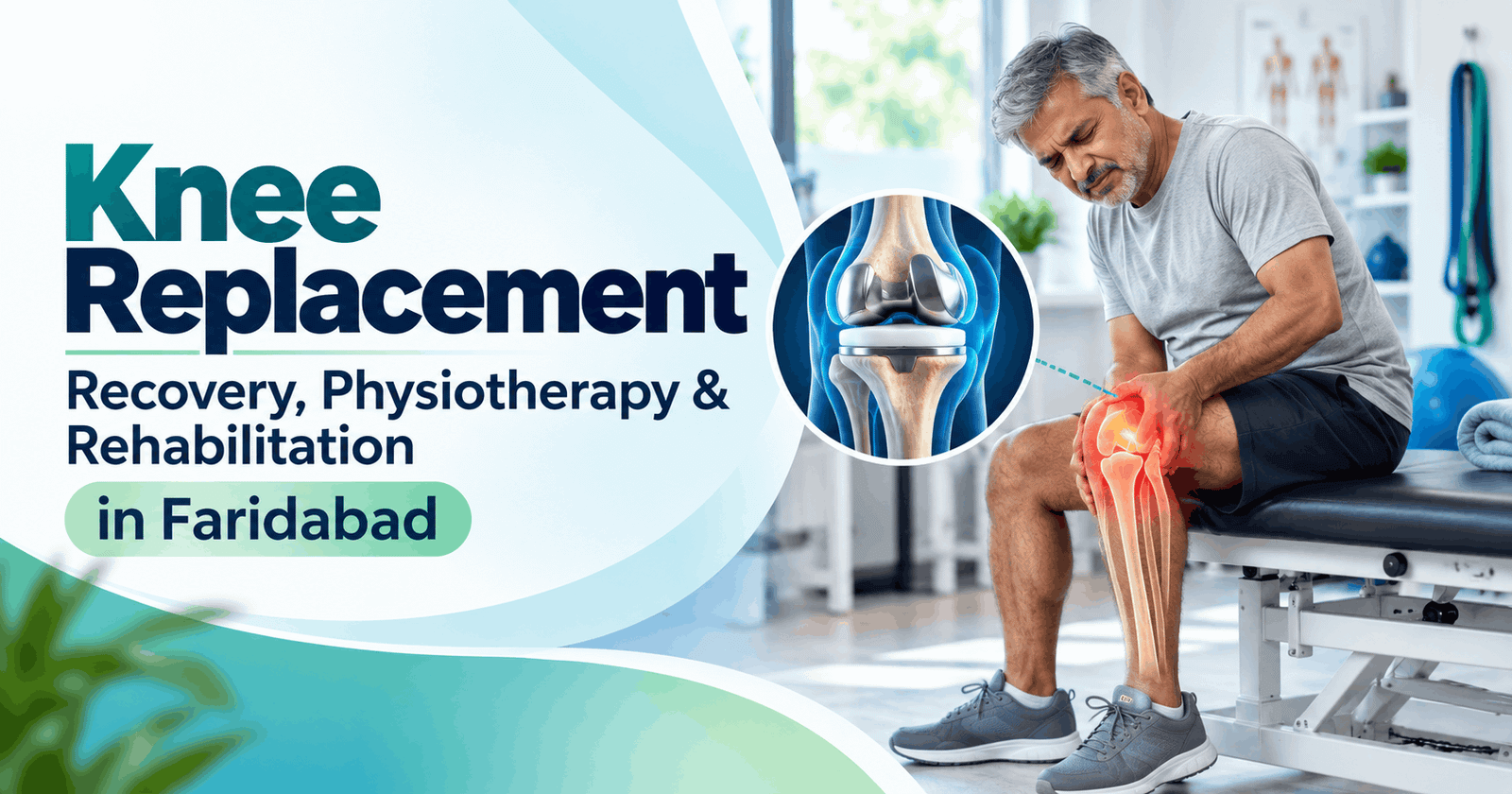
Knee replacement surgery can reduce severe knee pain and improve mobility when significant joint damage makes walking, climbing stairs or performing everyday activities difficult. However, surgery is only one part of the recovery process. Regaining knee movement, strength, balance and walking ability usually requires a structured rehabilitation programme.
Also called knee arthroplasty, the procedure replaces damaged portions of the knee joint with artificial components. Osteoarthritis is one of the most common reasons people undergo this operation. Mayo Clinic explains that damaged bone and cartilage are replaced with metal and plastic components to improve joint function and relieve pain.
At PhysioMotion Physiotherapy & Rehabilitation Clinic in Faridabad, rehabilitation after surgery is based on the individual patient’s healing stage, surgeon’s instructions, mobility, strength, swelling and functional goals. PhysioMotion’s existing post-operative rehabilitation programme specifically includes total knee replacement recovery.
What Is Knee Replacement?
A knee replacement is an orthopedic procedure performed when damaged parts of the knee joint are replaced with artificial components.
The operation may involve replacing the entire joint or only the damaged portion.
The main types include:
- Total knee replacement
- Partial knee replacement
- Revision knee replacement
During total knee arthroplasty, damaged surfaces of the femur and tibia are removed and replaced with artificial components. A plastic spacer helps create a smoother surface between the replacement parts.
The goal is not simply to replace the joint. The aim is to improve pain, mobility and everyday function.
Why Is Knee Replacement Surgery Done?
Severe osteoarthritis is one of the most common reasons for surgery.
Other situations may include:
- Advanced knee arthritis
- Significant joint degeneration
- Severe knee pain affecting daily activities
- Difficulty walking
- Difficulty climbing stairs
- Reduced knee movement
- Joint deformity
- Certain severe injuries
- Persistent symptoms despite conservative treatment
Mayo Clinic notes that surgeons assess factors such as knee movement, stability and strength when determining whether surgery may be appropriate.
Before surgery is considered, many patients may have already tried conservative management such as medication, activity modification, injections or physiotherapy.
Patients with persistent knee or joint problems can also explore PhysioMotion’s Orthopedic Rehabilitation in Faridabad service.
Knee Replacement and Osteoarthritis
Knee osteoarthritis gradually affects the cartilage and other structures within the joint.
Symptoms may include:
- Knee pain
- Stiffness
- Swelling
- Reduced movement
- Difficulty standing from a chair
- Difficulty climbing stairs
- Reduced walking tolerance
Not every person with osteoarthritis needs surgery.
Physical therapy may help improve strength, mobility and function in many people with knee osteoarthritis and may help some individuals delay surgery.
When symptoms become severe and significantly affect quality of life despite conservative management, knee replacement may be considered by an orthopedic surgeon.
9 Powerful Steps in Knee Replacement Recovery
Successful recovery is usually progressive rather than immediate.
1. Start Rehabilitation Early
After knee replacement, movement often begins relatively early according to the surgeon’s instructions and the patient’s medical condition.
A physiotherapist may initially help the patient:
- Sit safely
- Stand
- Transfer from bed to chair
- Walk using a walker or crutches
- Begin simple knee exercises
NHS guidance states that patients are usually helped to begin walking soon after surgery, initially using crutches or a walking frame.
PhysioMotion provides dedicated Pre & Post-Surgery Rehabilitation in Faridabad for patients recovering from total knee replacement and other orthopedic procedures.
2. Control Pain and Swelling
Pain and swelling are expected during the early stages of recovery.
Excessive swelling can make knee movement more difficult and may affect walking and muscle activation.
Management may involve:
- Medication prescribed by the medical team
- Elevation
- Appropriate cold therapy
- Compression where advised
- Gentle movement
- Activity modification
The exact approach should follow instructions provided by the surgeon and rehabilitation team.
3. Restore Knee Range of Motion
One major goal after knee replacement is gradually restoring the ability to bend and straighten the knee.
Range-of-motion exercises may include controlled knee bending and extension exercises.
The American Physical Therapy Association notes that early rehabilitation commonly focuses on restoring knee bending and straightening while managing swelling and walking ability.
Progress should be individualised rather than forcing the knee aggressively.
4. Rebuild Quadriceps Strength
The quadriceps muscles at the front of the thigh often become weaker after surgery.
These muscles play an important role in:
- Walking
- Standing
- Climbing stairs
- Controlling the knee
- Rising from a chair
A rehabilitation programme may progressively include quadriceps exercises, hip strengthening and lower-limb strengthening.
PhysioMotion’s Musculoskeletal Rehabilitation in Faridabad programme also focuses on restoring mobility, strength and functional movement.
5. Improve Walking Pattern
Many people use a walker or crutches early after surgery.
As strength and confidence improve, patients may gradually progress to less support when medically appropriate.
Walking rehabilitation may address:
- Step length
- Weight transfer
- Knee movement during walking
- Balance
- Use of walking aids
- Confidence
The NHS notes that walking aids are commonly used initially and are gradually reduced as patients become more confident.
6. Improve Balance
Reduced movement before surgery and weakness afterwards may affect balance.
Balance exercises can help improve:
- Stability
- Weight shifting
- Confidence
- Walking on different surfaces
- Fall prevention
This can be especially important in older adults.
PhysioMotion’s Geriatric Rehabilitation in Faridabad programme includes walking, balance and functional training and specifically lists hip and knee replacement recovery among the conditions it supports.
7. Practise Functional Activities
Rehabilitation after knee replacement should eventually move beyond basic exercises.
Patients need to regain the movements required in everyday life, including:
- Getting out of bed
- Standing from a chair
- Walking independently
- Using stairs
- Entering and exiting a vehicle
- Performing household activities
APTA guidance highlights functional training as an important stage of rehabilitation after total knee arthroplasty.
8. Progress Strength Gradually
As healing progresses, exercise difficulty can gradually increase.
Later rehabilitation may include:
- Sit-to-stand exercises
- Step-ups
- Controlled squats
- Resistance exercises
- Balance work
- Walking progression
- Endurance training
The programme should reflect the patient’s age, medical history, current strength and goals.
9. Return Safely to Normal Activities
The final goal of knee replacement rehabilitation is not simply achieving a certain knee angle.
Recovery should help patients return to meaningful activities such as:
- Independent walking
- Household activities
- Work
- Shopping
- Travel
- Recreational exercise
Low-impact activities such as walking, swimming and cycling are commonly used after recovery, whereas high-impact activities may not be appropriate for everyone. Mayo Clinic advises discussing long-term activity choices with the healthcare team.
Why Physiotherapy Is Important After Knee Replacement
Surgery replaces damaged joint surfaces, but it does not automatically restore:
- Strength
- Balance
- Mobility
- Walking mechanics
- Endurance
- Confidence
This is why physiotherapy forms an important part of knee replacement recovery.
APTA states that physical therapists help patients regain movement and function after total knee arthroplasty through individualised programmes involving mobility, strengthening, balance and functional training.
PhysioMotion’s post-operative rehabilitation approach includes pain and swelling management, range-of-motion exercises, strengthening, gait training, balance training and functional rehabilitation.
Knee Replacement Physiotherapy in Faridabad
At PhysioMotion, knee replacement physiotherapy in Faridabad begins with an assessment of the patient’s current stage of recovery.
Assessment may include:
- Pain
- Swelling
- Knee movement
- Muscle strength
- Walking ability
- Balance
- Use of walking aids
- Functional independence
- Surgeon-imposed precautions
Treatment is then progressed according to recovery rather than giving every patient the same exercise programme.
Learn more about PhysioMotion’s complete range of physiotherapy services in Faridabad.
What Happens During Knee Replacement Physiotherapy?
A typical rehabilitation programme may involve several components.
Range-of-Motion Training
Controlled bending and straightening exercises help restore knee mobility.
Muscle Strengthening
Exercises may target:
- Quadriceps
- Hamstrings
- Gluteal muscles
- Calf muscles
- Hip stabilisers
Walking Training
The physiotherapist may help the patient progress from a walker to crutches or a stick and eventually independent walking when appropriate.
Balance Training
Balance exercises can help reduce instability and improve movement confidence.
Functional Training
Exercises may practise real-life activities such as:
- Standing from a chair
- Stair climbing
- Walking
- Getting into a car
- Household movements
PhysioMotion’s Orthopedic Rehabilitation programme specifically includes total knee replacement recovery, gait training, mobility exercises, strength work and functional rehabilitation.
How Long Does Knee Replacement Recovery Take?
There is no identical recovery timeline for every patient.
Recovery depends on:
- Age
- General health
- Type of surgery
- Strength before surgery
- Knee mobility before surgery
- Medical conditions
- Surgical healing
- Rehabilitation participation
The NHS states that full recovery can take several months or longer and that individual recovery varies according to health and other factors.
Patients should therefore avoid comparing their progress too closely with someone else’s.
Knee Replacement Recovery Timeline
The following is a general guide only, not a fixed schedule.
Early Stage
The early phase commonly focuses on:
- Pain and swelling control
- Safe transfers
- Walking with assistance
- Knee bending and straightening
- Muscle activation
Following Weeks
Rehabilitation may increasingly focus on:
- Improving range of motion
- Strengthening
- Balance
- Walking quality
- Stair practice
Later Recovery
Treatment may progress toward:
- Greater walking endurance
- Functional independence
- Stronger lower limbs
- Normal daily activities
- Low-impact recreational exercise
Your surgeon’s protocol should always take priority.
Can Physiotherapy Start Before Knee Replacement?
Yes, when medically appropriate.
Physiotherapy before surgery is often called prehabilitation or prehab.
It may help patients:
- Improve strength
- Maintain joint mobility
- Practise exercises
- Learn to use walking aids
- Prepare the home environment
- Understand what to expect after surgery
APTA reports that physical therapists can help prepare patients before total knee replacement by improving strength and flexibility and teaching them how to use assistive devices.
PhysioMotion also provides pre-surgical rehabilitation as part of its Pre & Post-Surgery Rehabilitation service.
What Should You Avoid After Knee Replacement?
Restrictions depend on the surgeon and recovery stage.
During early recovery, patients may be advised to avoid activities such as:
- Twisting suddenly on the operated leg
- Heavy lifting
- High-impact exercise
- Returning to demanding activities too soon
- Ignoring weight-bearing restrictions
The NHS also advises patients to follow physiotherapy exercises and surgical guidance closely during recovery.
Never use a generic online exercise programme as a replacement for your surgeon’s specific precautions.
When Should You Contact Your Medical Team?
Certain symptoms after knee replacement need prompt medical attention.
Contact the surgeon or medical team if you develop symptoms such as:
- Increasing wound redness
- Discharge from the incision
- Fever
- Rapidly increasing swelling
- Severe calf pain
- Sudden shortness of breath
- Chest pain
- Severe or worsening pain
Knee replacement surgery carries recognised risks including infection and blood clots, so unusual or worsening symptoms should not be ignored.
Knee Replacement Rehabilitation for Older Adults
Many people undergoing knee arthroplasty are older adults.
Rehabilitation may therefore need to address more than the operated knee.
Some patients also need help improving:
- Overall strength
- Balance
- Walking confidence
- Endurance
- Transfers
- Fall prevention
PhysioMotion’s Geriatric Rehabilitation programme includes knee replacement recovery alongside balance, gait and mobility training.
Knee Replacement and Persistent Pain
Most patients undergo surgery to improve pain and function, but recovery is not always completely linear.
Some people may continue experiencing pain, stiffness or reduced confidence for longer than expected.
Persistent symptoms should be assessed rather than assuming that more aggressive exercises are always the answer.
PhysioMotion also provides Chronic Pain Management in Faridabad for patients experiencing persistent pain and reduced function following surgery or long-term musculoskeletal conditions.
Why Choose PhysioMotion for Knee Replacement Rehabilitation in Faridabad?
PhysioMotion provides personalised rehabilitation based on clinical assessment rather than using one standard protocol for every patient.
The clinic’s existing post-operative and orthopedic programmes include rehabilitation for total knee replacement, joint replacement recovery, gait problems, weakness and restricted movement.
PhysioMotion is led by Dr. Deeksha Choudhary, BPT, MPT (Orthopaedics) and focuses on musculoskeletal care, postoperative rehabilitation and geriatric rehabilitation.
Learn more about the clinic and its approach to rehabilitation. About PhysioMotion
Related PhysioMotion Guides
Building strong internal linking around related musculoskeletal and rehabilitation topics can help both users and Google understand the relationship between your content.
Useful related articles include:
- Lower Back Pain Reasons: 9 Powerful Causes to Know
- PIVD Treatment: 7 Powerful Steps for Better Recovery
- Cervical Pain Symptoms: 9 Powerful Warning Signs
- PhysioMotion Blogs
This helps strengthen the overall rehabilitation and orthopedic topical cluster on the website.
Frequently Asked Questions About Knee Replacement
Is physiotherapy necessary after knee replacement?
Physiotherapy is commonly an important part of knee replacement recovery because it helps restore movement, muscle strength, walking ability, balance and functional independence.
How soon can I walk after knee replacement?
Many patients begin supported walking soon after surgery, depending on their health, surgical procedure and medical instructions. A walker or crutches may initially be required.
How long does knee replacement recovery take?
Recovery varies. The NHS notes that full recovery may take several months or longer depending on factors such as age and overall health.
Can physiotherapy begin before surgery?
Yes. Prehabilitation may improve strength, mobility and familiarity with the exercises and walking aids used after surgery.
Can I climb stairs after surgery?
Patients are often gradually taught stair climbing as strength and mobility improve. The exact timing depends on the surgeon’s instructions and individual recovery.
Can I exercise after a knee replacement?
Yes, but activity should be gradually progressed. Low-impact activities are commonly preferred after recovery, while higher-impact exercise may need to be avoided or discussed with your surgeon.
Where can I get knee replacement physiotherapy in Faridabad?
PhysioMotion Physiotherapy & Rehabilitation Clinic provides personalised pre- and post-operative rehabilitation in Sector 89, Faridabad, including rehabilitation after total knee replacement.
Start Your Knee Replacement Recovery at PhysioMotion
A successful knee replacement journey does not end when surgery is completed.
Recovering mobility, strength, balance and independence requires gradual rehabilitation that respects the healing process and the surgeon’s instructions.
At PhysioMotion Physiotherapy & Rehabilitation Clinic, post-operative rehabilitation is planned around your current movement, strength, pain, swelling and functional goals.
Read genuine patient experiences on the PhysioMotion Reviews page or contact PhysioMotion to book a physiotherapy assessment in Faridabad.
This article is for educational purposes and does not replace personalised advice from your orthopedic surgeon, physician or physiotherapist.